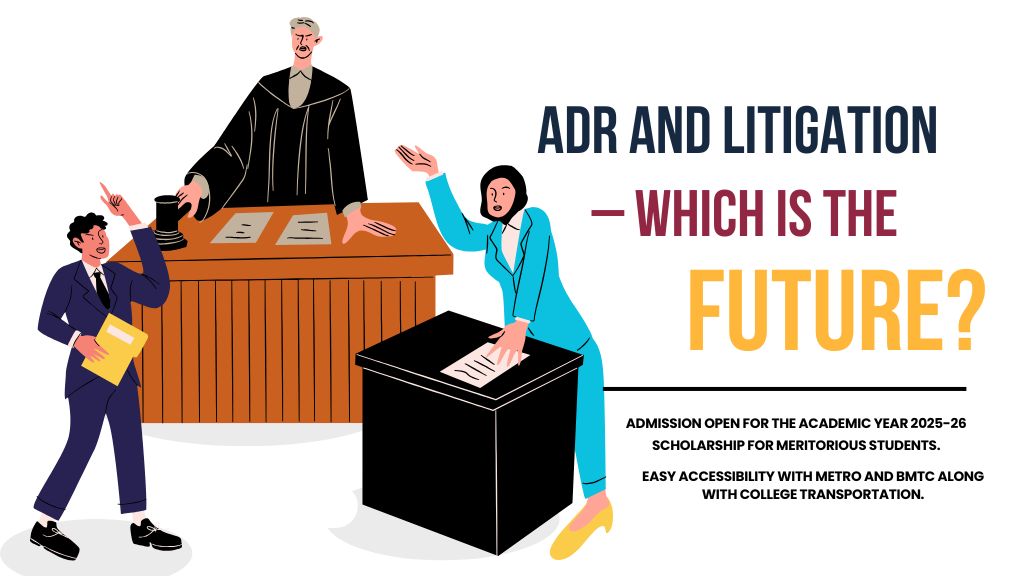
The legal world is evolving rapidly, and so are the methods of resolving disputes. Traditionally, litigation (court-based dispute resolution) has been the primary method. However, Alternative Dispute Resolution (ADR)—including arbitration, mediation, and conciliation—has gained prominence. The debate over ADR vs. Litigation is central to the future of justice delivery systems.
What is Litigation?
Litigation refers to resolving disputes through the court system. It involves:
Filing cases in courts, following strict procedures.
Evidence, witnesses, and cross-examinations.
A judgment delivered by judges.
Advantages:
Legally binding and enforceable decisions.
Suitable for complex constitutional and criminal matters.
Precedent-setting value.
Challenges of Litigation
Time-Consuming – Cases may drag on for years.
Expensive – High legal and court fees.
Public Exposure – Proceedings are part of the public record.
Strained Relationships – Adversarial nature may damage personal or business ties.
What is ADR (Alternative Dispute Resolution)?
ADR :
ADR is a set of mechanisms to resolve disputes outside traditional courts. The major types include.
Arbitration:
A neutral arbitrator gives a binding decision.
Mediation:
A mediator helps parties reach a voluntary agreement.
Conciliation:
Similar to mediation, but conciliators may suggest solutions.
Negotiation:
Direct discussions between parties to resolve disputes.
Benefits
Faster and more cost-effective.
Confidential and private.
Flexible procedures.
Preserves business and personal relationships.
Challenges of ADR
Limited Appeal – Arbitration decisions are binding with minimal appeal scope.
Unequal Bargaining Power –Risk of one party dominating.
Lack of Precedent –No value for future cases.
Global Enforcement Issues –Not always easy to enforce across borders.
Limited scope for criminal and constitutional disputes.
ADR AND LITIGATION – The Future Ahead
With an increasing backlog of cases in Indian courts (over 4.5 crore cases pending as of 2025), ADR is being promoted as a practical alternative. The Indian government and judiciary have encouraged arbitration and mediation, especially in commercial and family disputes.
However, litigation will never lose its relevance, especially for constitutional, criminal, and public law matters where only courts can provide authoritative judgments.
The future lies in a hybrid system:
Routine civil and commercial matters → ADR first approach
Long before this tech-era ruling, Section 89 of the Civil Procedure Code (CPC) empowered courts to refer cases to ADR mechanisms—mediation, arbitration, or conciliation—when settlement seems possible. This built-in provision laid the foundation for encouraging out-of-court dispute resolution.
Afcons Infrastructure Ltd. v. Cherian Varkey Construction Co. (P) Ltd. (2010) 8 SCC 24
The Supreme Court clarified the scope of Section 89 CPC and emphasized that courts should encourage ADR to reduce litigation backlog.
Conclusion:
ADR is emerging as the future of dispute resolution, particularly in business, trade, family, and international disputes. Litigation will continue to play a vital role where the authority of courts is irreplaceable. Together, ADR and litigation will shape a more efficient, accessible, and balanced justice system for the future.