
Civil Suit in India:A Comprehensive
Guide to Filing,Process,
and 2026 Reforms

Introduction
In the evolving landscape of Indian justice, a civil suit serves as the primary mechanism for individuals and entities to seek redress for harms to their personal rights, property, or financial interests. Unlike the criminal justice system, which focuses on punishment and incarceration, the civil system is restorative, aiming to return the injured party to their original position through compensation or specific judicial orders.
I. Defining the Civil Suit.

A civil suit is a legal proceeding governed by the Code of Civil Procedure (CPC), 1908. Under Section 26 of the CPC, a suit is officially instituted upon the presentation of a “plaint”—a formal document detailing the grievances and the relief sought.
The legal standard in these cases is the preponderance of probabilities. This means the court decides based on which side’s version of events is more likely to be true, a threshold notably lower than the “beyond reasonable doubt” standard required in criminal law.
II. Core Categories of Civil Litigation.
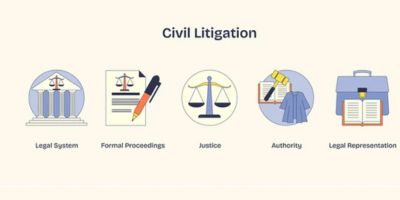
Civil suits address a broad spectrum of non-criminal disputes that are essential to a functioning economy and society:
Property and Land: Actions for recovery of possession, partition of ancestral property, or removal of encroachments under the Specific Relief Act, 1963.
Contractual Disputes: Suits for breach of contract, unpaid invoices, or service defaults governed by the Indian Contract Act, 1872.
Money Recovery: Direct claims for loans, salaries, or damages restricted by the Limitation Act, which generally mandates filing within three years of the cause of action.
Family Law: Matters of divorce, alimony, and child custody, primarily governed by personal laws such as the Hindu Marriage Act, 1955.
Digital and Cyber Disputes: Recovery for cyber fraud or online defamation under the Information Technology Act, 2000.
III. The Streamlined Litigation Process (2026 Standards)
The transition to e-Courts Phase III has fundamentally altered the lifecycle of a civil suit in India.
Institution (The Plaint): The plaintiff e-files a digital plaint via the national e-Courts portal. This document must include the facts of the case, the specific relief requested, and the payment of ad valorem court fees.
Summons and Written Statement: The court issues an electronic summons to the defendant. Under Order VIII of the CPC, the defendant must file a “Written Statement” within 30 days (extendable to 120 days in commercial suits).
Interim Relief: If there is a risk of the property being sold or destroyed during the trial, the plaintiff can apply for a “Temporary Injunction” under Order 39 to maintain the status quo.
Framing of Issues and Evidence: The judge identifies the specific points of conflict. Evidence is now largely submitted through digital affidavits. The Bharatiya Sakshya Adhiniyam (BSA), 2023, now governs the admissibility of electronic records, requiring hash value certifications for integrity.
Final Arguments and Decree: Following the examination of witnesses (often conducted via secure video conferencing), the court delivers a “Decree”—the formal expression of an adjudication that conclusively determines the rights of the parties.
IV. Evaluating the System: Benefits and Challenges.
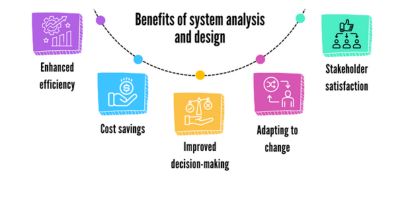
The civil litigation system provides a structured and impartial arena for dispute resolution, yet it faces operational hurdles.
Advantages: It provides legally binding decrees that can be enforced through the court’s execution powers (arrest of a debtor or attachment of property). It also encourages settlement through Lok Adalats, or court-annexed mediation, which currently resolves approximately 65% of matrimonial and property disputes before they reach trial.
Drawbacks: Despite digitization, the sheer volume of cases (approximately 1.1 crore pending civil matters) can lead to delays. Additionally, the cost of litigation, including court fees and professional legal representation, remains a barrier for low-income litigants, though NALSA (National Legal Services Authority) provides aid in many instances.
V. Major 2025-2026 Reforms.
India has introduced several “turbo-charging” reforms to ensure the ease of justice:
AI-Integrated Backlog Management: Tools like SUVAS and SUPACE are now fully operational, assisting judges in researching precedents and translating judgments into 22 scheduled languages, significantly reducing the time spent on administrative tasks.
Pre-Institution Mediation: For commercial disputes, mediation is now a mandatory first step, preventing the court system from being overwhelmed by cases that could be settled through negotiation.
Blockchain Evidence: Following 2025 updates to digital evidence rules, blockchain-stored records are increasingly recognized as tamper-proof evidence, reducing the time spent on verifying the authenticity of documents.
Digital Execution: New protocols allow for the electronic attachment of bank accounts and assets, making the enforcement of a court decree much faster than the traditional physical bailiff system.
VI. Frequently Asked Questions.
1. Can I file a civil suit online?
Yes. As of 2026, the e-filing module is mandatory for most commercial and high court matters and is available across almost all district courts in India.
2. What happens if the defendant ignores the summons?
If the court is satisfied that the summons was served, it may proceed ex parte (in the absence of the defendant) and pass a decree in favor of the plaintiff.
3. How long does a civil suit take?
In reformed “fast-track” commercial courts, cases are increasingly resolved within 6 to 12 months. However, complex property disputes in traditional courts may still take 2 to 4 years.
4. What are the costs involved?
The primary costs are the court fee (a percentage of the claim value) and the lawyer’s professional fee. Digital filing has eliminated many of the “incidental” costs associated with physical paperwork.
In the 2026 legal landscape, choosing between a traditional civil suit and a commercial suit is a critical strategic decision. While both follow the Code of Civil Procedure (CPC), the Commercial Courts Act, 2015 (with its 2024 and 2025 amendments), introduces a specialized “fast-track” regime for business-related disputes.
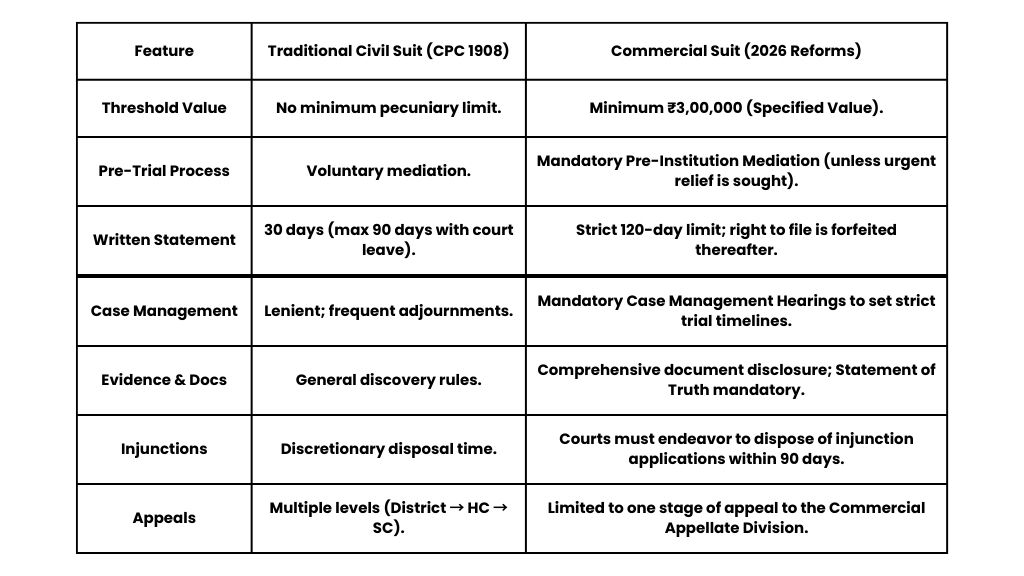
Critical 2025-2026 Procedural Updates
- Mandatory Pre-Institution Mediation (PIM)
Under Section 12A, you cannot file a commercial suit without first attempting mediation through the Legal Services Authority. In 2025, the Supreme Court reaffirmed that failing to do so results in an automatic rejection of the plaint (Order VII Rule 11).
- The “Pause” Button: The time spent in mediation (up to 3-5 months) is excluded from your 3-year limitation period.
- The Settlement: A settlement reached in PIM has the status of an Arbitral Award, making it directly executable in court if the other party defaults.
- Electronic Mode as the Default.
Following the 2025 Digital Justice guidelines, commercial courts now operate on an “electronic-first” basis:
- Digital Summons: Service via encrypted email or authenticated messaging apps is now standard.
- Virtual Evidence: Witnesses are increasingly examined via secure video links, reducing trial duration by nearly 50%.
- Cost and “Summary Judgments”
Commercial courts have the power to pass a Summary Judgment (Order XIII-A) without a full trial if one party has “no real prospect” of succeeding. This is a powerful tool to clear frivolous commercial cases in under 6 months.
Which Path Should You Choose?
- Choose Traditional: For family disputes, personal property rows, or money claims below ₹3 Lakhs.
- Choose Commercial: For partnership splits, IPR issues, insurance claims, or any business-to-business (B2B) conflict. The higher court fees are usually offset by the speed of recovery and the court’s ability to award “actual costs” (including lawyer fees) to the winner.
Conclusion.
Civil suits in India have become faster, more transparent, and technology-driven due to recent reforms. Understanding these changes helps litigants and legal professionals choose the most effective path to justice.
civil suit meaning, what is a civil suit, types of civil suits in india, how to file a civil suit, civil court procedure, civil suit in india, filing a civil suit, how to file a lawsuit against a company, how to file a civil lawsuit, how to file a wrongful death lawsuit, civil lawsuit for car accident, file a lawsuit against a company, how do i file a lawsuit, how to file a personal injury lawsuit, file a lawsuit online, how to file a civil suit, civil suit for car accident, how to file lawsuit for car accident, how do you file a lawsuit, file a lawsuit against employer, how to file civil suit for car accident, how to file a defamation lawsuit, i want to file a lawsuit, how do i file a civil suit, file a civil suit online, file civil lawsuit, how to file a small claims lawsuit, how do you file a wrongful death lawsuit, filing a personal injury lawsuit, civil action lawsuit